


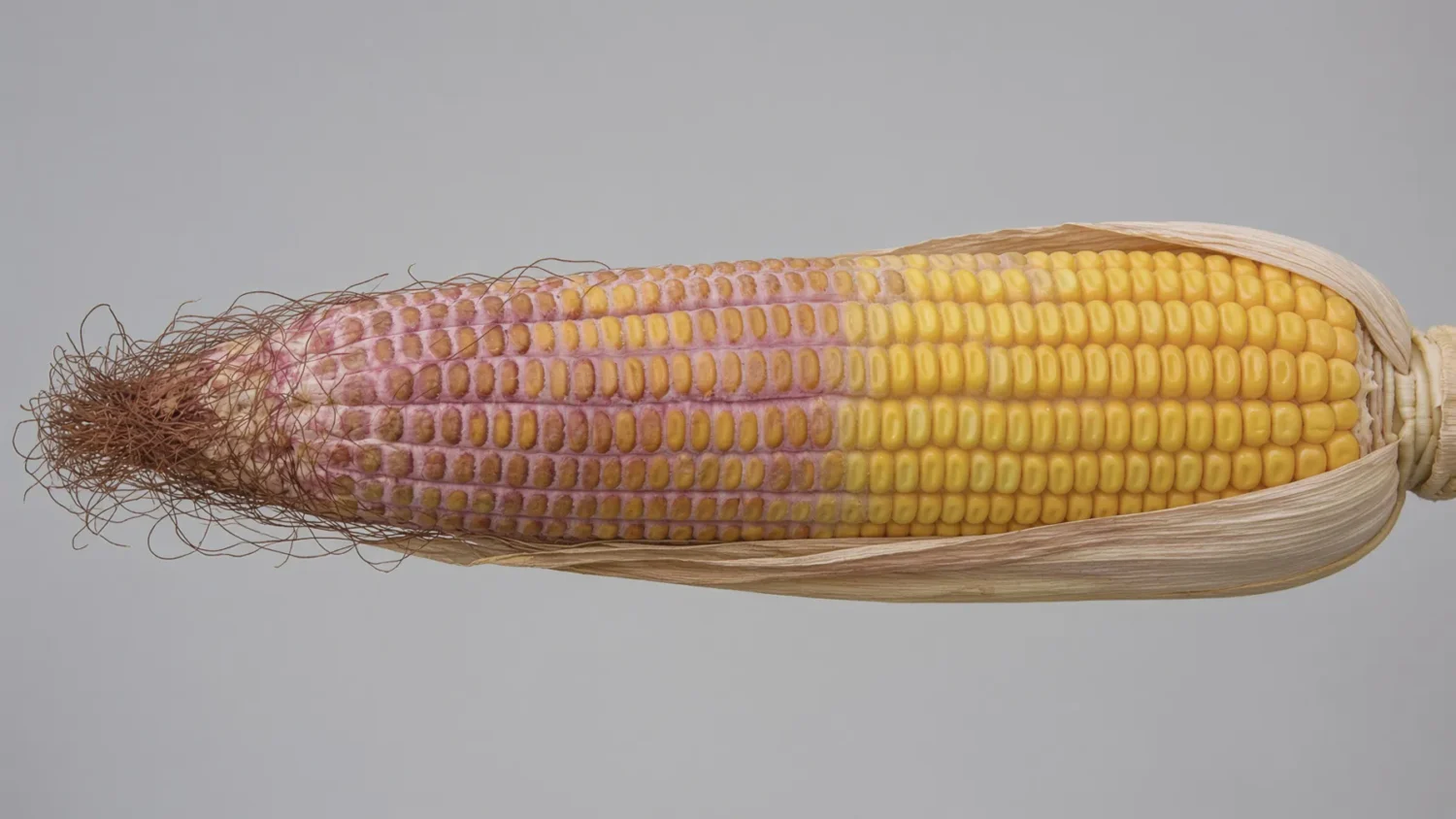
Every year, mold appears on corn ears in Quebec. This affects grain quality and, in some cases, can produce mycotoxins that poison animals. Effective screening helps identify problems early, and best practices help minimize losses.
Why it develops
The fungi responsible survive in the soil and on crop residues. Rainy conditions promote the production and release of spores, which are then dispersed by wind, rain splash, insects or birds. Infection of the ears occurs mainly through the silks (especially in the days following their emergence) or through injuries caused by insects, birds, hail or frost.
After infection, mold development depends on weather conditions. A cool, humid fall or an early frost before maturity favors the problem. Crop residues left on the surface also increase the risk.
How to recognize them
Important: Seeing mold does not necessarily mean there are mycotoxins. The reverse is also true. That’s why suspect lots must be analyzed.
| Mold | What it looks like | Mycotoxins | Key points |
|---|---|---|---|
| Gibberella (Fusarium graminearum) | Pink to reddish mold, often starting from the tip of the ear or from an injury. The husks stick to the kernels. | Deoxynivalenol (DON or vomitoxin), zearalenone | The most common in eastern Canada. Also attacks cereals. |
| Fusarium verticillioides | White to pink mold. Infected kernels are scattered throughout. Sometimes white streaks. | Fumonisin | Enters mainly through the silks or injuries. |
| Dry rot (Diplodia) | Dense white mold starting at the base of the ear. Kernels appear stuck to the husks and cobs by white mycelium. Sometimes small black bumps (pycnidia). | None | The rest of the plant often stays green. |
| Common smut | Greyish galls that turn black and powdery, often at the tip of the ear. | None | Impressive to see, but no toxins. Favored by injuries and excess nitrogen. |
| Others (Penicillium, etc.) | Green, blue-green, grey or black depending on the fungus. | Variable (ochratoxin possible with Penicillium if poorly stored) | Often linked to injuries or excessive moisture. |

Mycotoxin standards vary depending on the intended use of the grain.
Generally, for animals:
- Around 1 ppm of deoxynivalenol (DON) for pigs, calves and lactating cows.
- Up to 5 ppm for beef cattle and poultry.
- La Financière agricole du Québec compensates starting at 2 ppm for corn.
Good nabits to keep up
Scouting
Around mid-September (dough stage), check at least 30 ears in different areas of the field. Peel back the husks to see what’s inside. If the percentage of affected ears is high (often around 10% for fusarium), plan to harvest that field first.
At harvest
- Harvest the most affected areas separately (field edges, areas where birds have been active).
- Adjust the combine to better remove light and broken kernels (strong fan, proper settings).
- Dry quickly to a maximum of 14–15% moisture. Above that, molds continue to produce toxins.
- Have a representative sample analyzed (several samples mixed) for the main mycotoxins (deoxynivalenol/DON, zearalenone, fumonisin as appropriate).
Storage
Monitor temperature and odors. In cribs, fungal growth stops once the grain is dried or ensiled (when ensiling conditions are adequate), but the mycotoxin content remains unchanged.
For future years
We can’t control the weather, but we can still reduce the risks:
- Rotation and tillage: Less corn and cereal residue on the surface. In no-till or reduced tillage, rotations become even more important.
- Adapted hybrids: Choose hybrids that mature well in your zone and have good relative resistance to ear molds.
- Insects: Bt hybrids reduce injuries from European corn borer and western bean cutworm, meaning fewer entry points for fungi.
- Field management: Avoid compaction and ensure good drainage.
- Fungicides: There are products registered for ear fusarium. Talk to your expert-advisor; they can advise you.
- Monitor insects.
Common smut is spectacular, but it does not produce mycotoxins. In general, it does not prevent ensiling, even if it can slightly reduce energy value.
In summary
Ear molds return frequently in Quebec, but they can be managed. Recognize them well, scout early, harvest and dry suspect lots quickly, and have them analyzed before feeding to animals. Over the longer term, rotation, hybrid choice and reducing insect injuries remain the best ways to prevent problems.
For analyses or advice tailored to your situation, talk to your Uniag expert-advisor or an accredited lab. Every year is different: stay attentive at harvest.
Article reviewed by Catherine St-Aubin, T.P., Kamel Hamidouche, Agr., and Jonathan Messerli, Agr., M.Sc.
Sources
Réseau d’avertissements phytosanitaires (RAP). (2026). Les moisissures de l’épi du maïs-grain (fiche technique – Grandes cultures). Agri-Réseau. Updated November 5, 2026.
Perreault, S. (2026, October 23). Bulletin technique : Moisissures dans le maïs. Sollio Agriculture.
