

The company’s consumer segment is better known under the name W. H. Perron, which sells its seed packets throughout the province, notably through its online catalog as well as in several BMR and Agrizone locations within the cooperative network. However, this recognition does not fully reflect its commercial segment—that is, the wide range of seeds adopted by many small and large market gardeners across Quebec. So, who is Norseco?
Founded in 1928, the company was acquired in 2014 by two of its employees, Christine Ruckstuhl, Head of Research and Purchasing, and Christian Chartrand, General Manager, along with Uniag Cooperative.
Norseco has continued to expand ever since. Its seed catalog now includes more than 4,000 varieties of fruits, vegetables, herbs, and ornamental plants. The company also produces and distributes a variety of tropical and indoor plants.
New international varieties tailored for Canada
Norseco’s core business, however, remains vegetable production seeds, which is not always an easy task across Canada. The relatively small number of acres dedicated to fruits and vegetables unfortunately does not encourage major global breeders to conduct research aimed at developing seeds specifically suited to our climate.
“They rarely breed specifically for the Canadian market,” explains Christine, “except for carrots, onions, and peppers, for which we carry out preliminary selection adapted to local conditions. These are important crops. For other crops, at Norseco, we try to identify, among what is available elsewhere, what works best here.”
“The advantage of our position is that we have access to genetics from around the world,” adds the seed specialist, noting that she works with nearly 80 global suppliers.
Selecting fruit and vegetable varieties
The full process therefore begins with the breeder, who develops new crosses. This is followed by preliminary selection, during which the breeder further advances these varieties by testing them in different climates.
Norseco then takes over to evaluate the selected varieties and test them specifically for the Canadian climate.
Evaluation criteria
- Yield
- Color
- Texture
- Size and shape
- Disease and insect resistance
- Consistency
- Maturity
- Appearance
- Market requirements
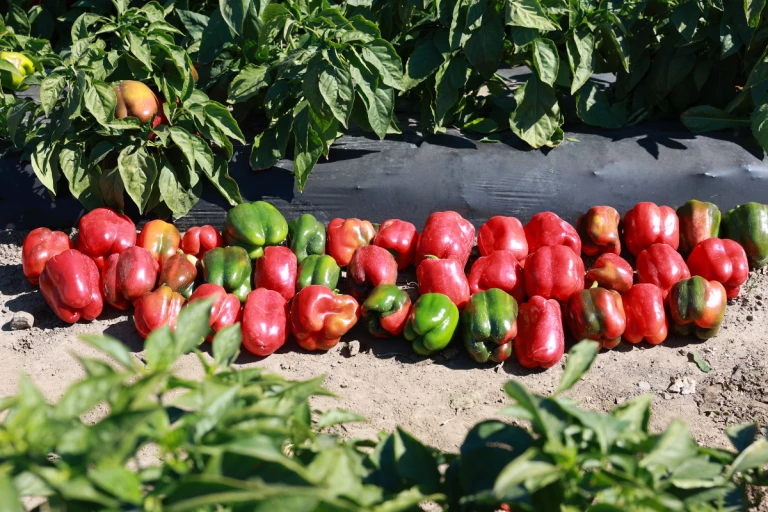
A pumpkin with a stem that is too pale or a pepper that is too elongated could be rejected. The market dictates customer preferences—not just yield.
Soil types also play a role. Sandy soils, black soils, across Quebec and Ontario… More than twenty valuable partner growers host the approximately 800 varieties tested annually by Norseco across 40 to 50 trial plots.
Coordination with growers is crucial. They are Norseco’s eyes in the field on a day-to-day basis. Are the lettuces ready? A quick call, and it’s time for a field visit—ideally before harvest—for evaluation. And it has to happen quickly: lettuce doesn’t wait!
The top-performing varieties then move on to pre-commercial trials for final large-scale testing with a broader group of clients. If results are successful, the variety may then be added to the catalog. (Read “How to Select Fruit and Vegetable Varieties” to learn more about the selection process.)




From the smallest to the largest market gardener
Norseco is a major seed company in Quebec. While it could focus solely on large-scale market gardeners, its owners are committed to also offering smaller formats tailored to more modest producers.
“For a grower looking to purchase seeds, there aren’t a thousand options in Quebec,” explains Christine. “We have a responsibility to offer a strong selection for everyone—both small and large producers.”
— Christine Ruckstuhl, Head of Research and Purchasing
“A few years ago,” she adds, “we also explored launching an organic seed catalog. The organic sector includes many producers, often working on smaller acreages. They need support too!”
Seed preparation and coating
Fall is a busy period, both for evaluating varieties and preparing for the year ahead. “Delivery logistics are critical, especially for early-season crops. The earlier we work with suppliers, the better we can ensure on-time delivery.”
Around fifteen seed treatments (pre-germination, coating, or pelleting) are also offered. However, everything is done directly in the United States, so logistics must be perfectly coordinated to ensure treated seeds are delivered to customers in time for the planting season.
Will tariffs have an impact? “Yes, there will be increases,” says Christine, adding that the real issue is not so much tariffs between Canada and the United States, but rather those imposed by the U.S. on other countries. As mentioned earlier, seeds come from all over the world, but they largely transit through the United States. At that point, some are subject to tariffs while others are not, depending on their origin. That’s what will have an impact—much to Christine’s disappointment, as she would certainly have preferred to avoid the consequences of U.S. policies.
Choosing the best varieties: an evolving expertise
While Christine has become an expert in selecting different crops, she didn’t always have such a sharp eye for the many categories offered by Norseco.
“Broccoli is easier to evaluate—it’s either beautiful or it’s not! Onions, I’ve learned to master. I now notice the finer details from one onion to another, whereas at the beginning, they all looked the same to me.”
— Christine Ruckstuhl, Head of Research and Purchasing at Norseco
Cabbages, even today, remain complex to assess because, much like onions, their appearance is often very similar. Lettuce, on the other hand, is a demanding crop in Quebec, and results are often inconsistent. “Our climate isn’t ideal for lettuce,” she adds, noting that evaluation must also be done quickly, since once lettuce is ready in the field, it doesn’t stay at peak quality for long before bolting.
Finally, hidden beneath the soil lies one of Christine’s favorite crops: carrots. “I like carrots because you don’t see them grow. You only see the foliage all season, and if you pull them too early, that’s it—you’ve lost them. You really have to wait. You have no idea what the root looks like! With other crops, you can see what’s coming, but with carrots, it’s always a surprise.”
And sometimes, that surprise becomes a crisp new variety added to the catalog at the end of the season.
Article by Stéphanie McDuff, published on the Le Coopérateur website.